
Our team also needs a second brain
"Where are we at with the Dearworks contract right now?"
There is definitely a related email, a meeting scheduled, and files exchanged. But to answer right away, you have to open multiple tools and check again from the most recent records.
We record a lot of things every day, but at the very moment we need them, we cannot remember them all at once.
Dearworks connects scattered records to remember the context of our team's work. It links who requested what, what conversation was held, and what needs to be done next into a single flow.
That is why we call Dearworks our team's second brain.
We record every day, but at the very moment we need it, we cannot remember
While we work, records keep accumulating.
Customer requests are left in emails, and meetings are scheduled on calendars. Conversations during meetings remain within the dialogue, while proposals and contracts are kept as files.
The problem is not that there are no records. It is that the necessary information is split across multiple places.
To check what was decided in the last meeting, you have to re-read emails, find the schedule on the calendar, and even open the relevant files. Records accumulate every day, but a human must gather the necessary context again.

Even if the information exists, the relationship is disconnected
Just by looking at a single email, you can tell what the customer requested. Just by looking at a single event, you can also tell when the meeting was.
But to understand the actual work, you need the relationships in between.
Which customer and project is this email about?
Which meeting did this request lead to?
What was decided during the meeting?
Which files were exchanged?
Who needs to do what next?
If each piece of information is separate, you may be able to find the search results, but it is difficult to know the entire flow of the work.
What our team needs is not a space to stack more records, but a structure that remembers the relationships among scattered records.

Dearworks connects even the flow of work
Dearworks does not look at people, emails, schedules, and files separately.
It organizes the relationships between information, such as who sent the email, what schedule it was connected to, and what files were exchanged.
It connects records that were scattered as individual dots into lines, creating a flow of how the work progressed.
This connection structure is called a knowledge graph.
For example, the process of discussing a contract with Dearworks can be linked like this:
Contract inquiry email → Meeting with the manager → Negotiation of terms → Sharing the contract → Request for revision → Next schedule
When this flow is connected, it doesn't just end with finding a specific document. You can also understand what has been in progress so far and what needs to be done next.
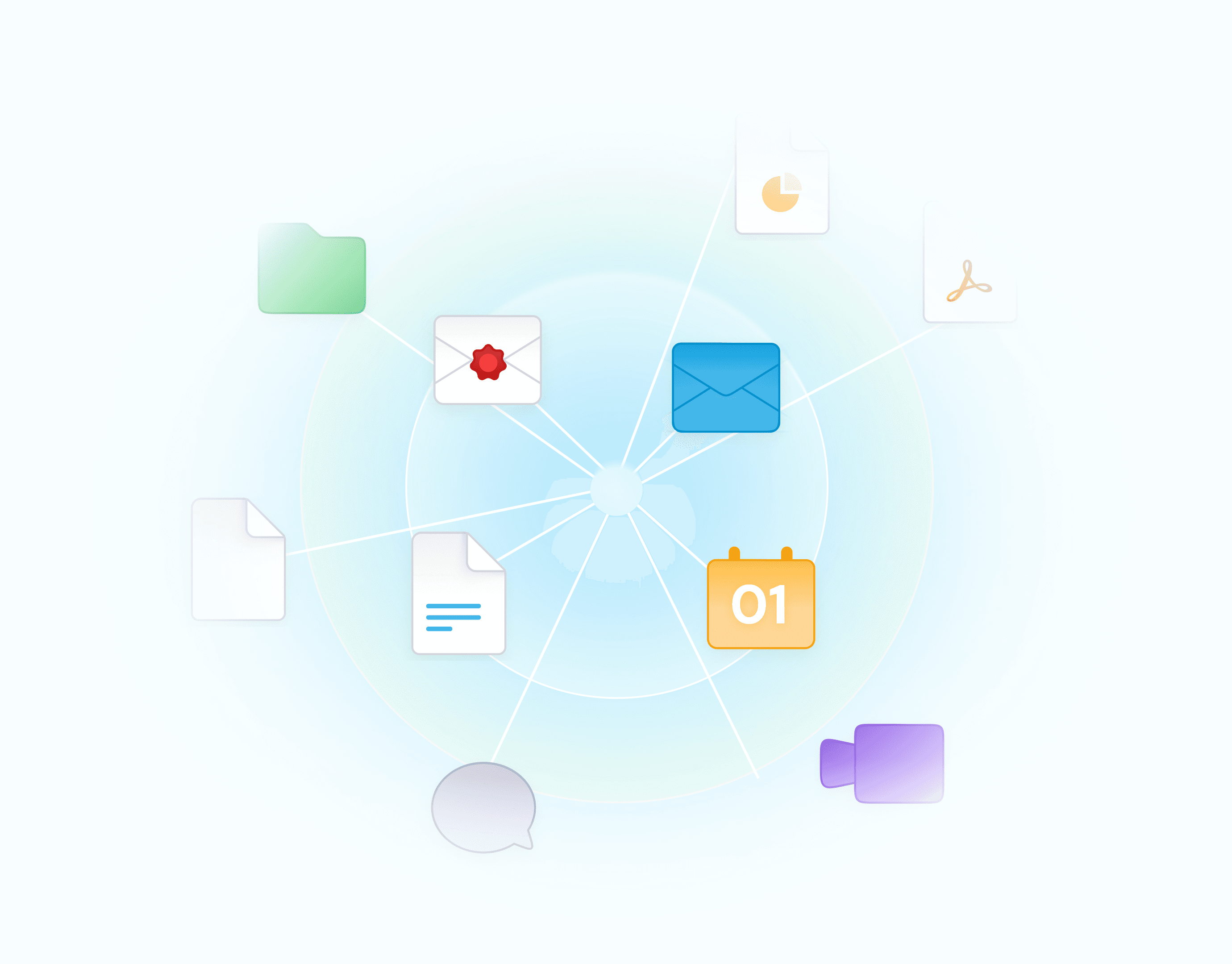
From emails to schedules and files, we connect everything in one flow
Users do not need to reorganize their work to create a second brain.
Just check emails, create schedules, and exchange files as usual. Dearworks connects the people, companies, conversations, and schedules involved in the process where work is created.
Identify requests and assignees from emails.
Connect related meetings and next schedules on the calendar.
Find proposals and contracts on the Drive together.
Link previous conversations and decisions into a single context.
You don't need to create new folders or tag every record. Your team's work context accumulates naturally as you work as usual.
Just ask what you are curious about, and it finds the necessary context
When the relationships of work are connected, questions also become shorter.
"Where are we at with the Dearworks contract right now?"

You don't need to explain the situation from the beginning or paste related materials one by one.
Dearworks finds the emails, schedules, assignees, and files connected to the question. Then, it summarizes the progress made so far, major decisions, remaining tasks, and the next schedule all at once.
You can also check which records each answer was based on. If necessary, you can go back to the original email or file to look into it yourself.
Dearworks finds the context, and the user only needs to ask what they are curious about.
Connect your team's work context to Dearworks
Our team's records are already sufficient.
Emails, schedules, conversations, and files are accumulating every day. What is needed now is not to record more, but to connect how the scattered information relates to each other.
Dearworks links the records left by our team into a single work context, so that you can reduce the time spent searching for past work and quickly check the current situation and what to do next.
Our team's second brain is not an AI that remembers everything on our behalf.
It is an AI that connects scattered records and continues the next work at the moment it is needed.
Connect your team's work context to Dearworks.